

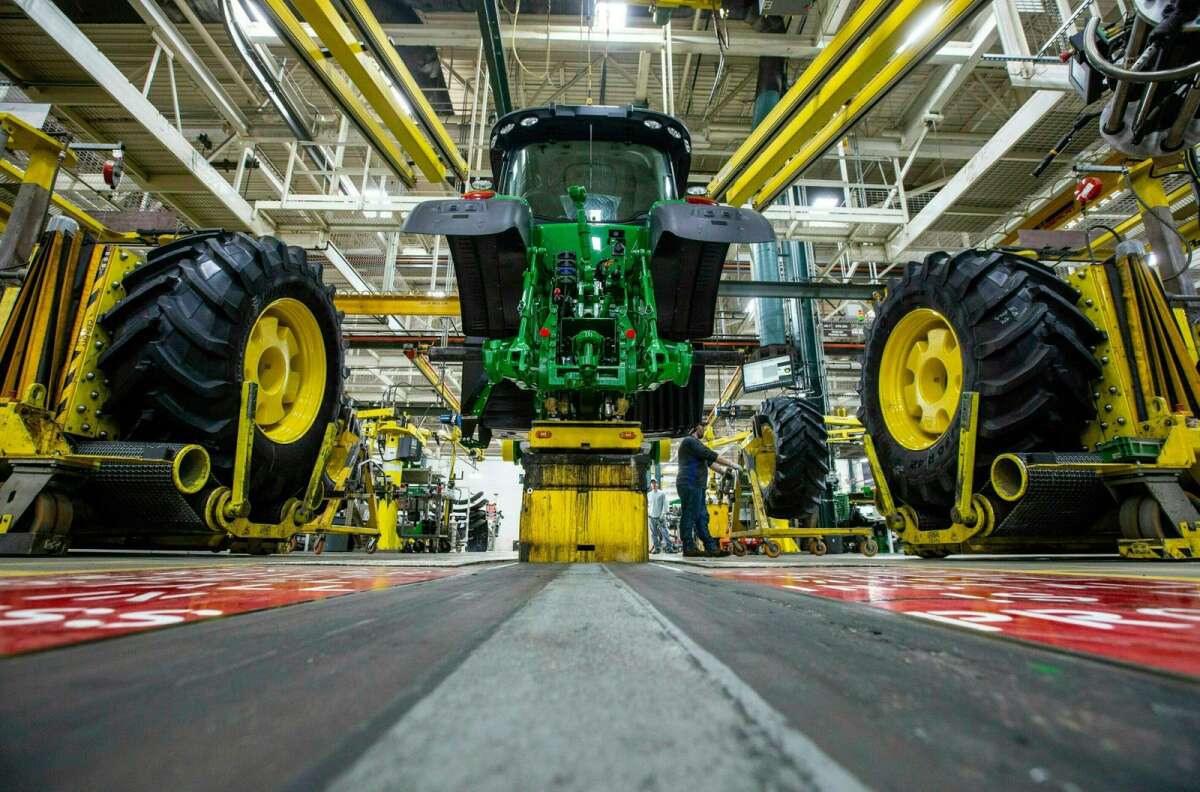
John Deere tractors are manufactured in 14+ facilities across the globe. The flagship Waterloo, Iowa plant produces large agricultural tractors (7R, 8R, 9R series), while Augusta, Georgia handles compact utility models (1-5 series).
- USA Manufacturing Locations: American-Made John Deere Tractors
- International Manufacturing: John Deere’s Global Production Network
- The Right-to-Repair Controversy: Why Manufacturing Location Matters
- Made in USA vs. Import: What It Really Means
- Quick Reference: Tractor Series by Origin
- Technology & Modern Production
- FAQ: Common Questions About John Deere Manufacturing
International facilities in Germany, India, China, and Mexico serve regional markets with specific model lines.
John Deere has been manufacturing tractors since 1918, when it acquired the Waterloo Gasoline Engine Company.
Waterloo Tractor Operations remains John Deere’s largest manufacturing complex globally, producing the company’s most powerful agricultural equipment. But where exactly are these iconic green machines made, and does location affect quality or your ability to maintain them?
USA Manufacturing Locations: American-Made John Deere Tractors
Waterloo, Iowa – The Flagship Factory
Waterloo produces John Deere’s largest and highest horsepower tractors, including the new 9RX series with up to 830 horsepower. This massive complex started tractor production in 1918 and continues to be the heart of John Deere’s agricultural equipment manufacturing.
Models Produced:
- 7R Series – Row crop tractors (210-330 hp)
- 8R Series – High-horsepower row crop (230-410 hp)
- 9R/9RX Series – Articulated 4WD tractors (470-830 hp)
The Waterloo facility recently expanded to include a new 9RX High-Horse Power tractor assembly line to better support customers. The 9RX830, designed entirely in nearby Cedar Falls, represents the company’s most advanced tractor technology with 830 horsepower and four-track articulated design.
Recent Investments: John Deere announced a $20 billion investment across U.S. operations over the next decade, with significant portions going to Waterloo facility upgrades and new assembly lines.
Augusta, Georgia – Compact & Utility Tractor Hub
The Augusta factory, established in 1990, specializes in compact and utility tractors for homeowners, small farmers, and commercial users. Augusta builds the 1 Family, 2 Family, 3 Family, and 4 Family Compact Utility Tractors, plus the 5 Family Utility Tractors.
Models Produced:
- 1 Series – Sub-compact (22-25 hp)
- 2 Series – Compact utility (24-25 hp)
- 3 Series – Compact utility (25-43 hp)
- 4 Series – Utility tractors (44-66 hp)
- 5 Series – Utility tractors (75-115 hp)
The factory has produced over one million tractors since opening and currently manufactures 27 different models. These tractors are distributed throughout North America and exported to more than 40 countries.
Important Note: While assembled in Augusta, some components like engines come from Yanmar (Japan) through a partnership arrangement. This is standard in modern manufacturing but means “Made in USA” refers to final assembly location.
Greeneville, Tennessee – Lawn & Garden Equipment
Greeneville focuses on residential and commercial lawn equipment, including lawn tractors and zero-turn mowers.
Models Produced:
- X300 Series – Lawn tractors
- X500 Series – Premium lawn tractors
- X700 Series – Commercial-grade tractors
- Z Series – Zero-turn mowers
Horicon, Wisconsin – Residential Equipment
Horicon manufactures consumer-focused equipment for homeowners and light commercial use.
Models Produced:
- Z500 Series – Residential zero-turn mowers
- X100 Series – Entry-level lawn tractors
- X300 Series – Mid-range lawn tractors
International Manufacturing: John Deere’s Global Production Network
Mannheim, Germany – European Powerhouse
The Mannheim plant produces around 40,000 tractors annually of the 6M and 6R series, making it John Deere’s largest manufacturing asset outside North America. The facility produces tractors ranging from 70 to over 200 horsepower.
Models Produced:
- 6M Series – Mid-range row crop (110-155 hp)
- 6R Series – Row crop tractors (110-250 hp)
- 7R Series – Large row crop (select models for EU market)
The Mannheim factory manufactures its own transmissions, with around 350,000 gears produced annually. In spring 2023, the two-millionth tractor rolled off the Mannheim assembly line, showcasing the facility’s massive production capacity.
About 50% of Mannheim’s production is shipped globally via Rotterdam and Antwerp ports, while the other half serves the European market via truck.
Pune & Dewas, India – Asian Market Focus
India’s facilities produce tractors specifically designed for smaller farms and regional agricultural needs.
Models Produced:
- 5E Series – Utility tractors (45-75 hp) optimized for Asian markets (like 5075E)
- 3 Series – Compact tractors for small holdings
Saltillo, Mexico – North American Support
Mexico’s Saltillo plant produces mid-range tractors primarily for the North American market.
Models Produced:
- 5M Series – Utility tractors (75-115 hp)
- 6M Series – Mid-range tractors (110-140 hp)
Tianjin, Ningbo & Harbin, China
China’s three facilities focus on compact tractors and equipment for the Asian-Pacific region, producing smaller horsepower models (under 60 hp) tailored to regional farming operations.
Other International Locations
Rosario, Argentina – Agricultural tractors for South American market
Montenegro, Brazil – Agricultural tractors and specialty equipment
Moscow/Domodedovo, Russia – Regional agricultural equipment (production status uncertain due to geopolitical factors)
The Right-to-Repair Controversy: Why Manufacturing Location Matters
Where your tractor is made affects more than just its origin story—it impacts your ability to repair and maintain it. In January 2025, the Federal Trade Commission, along with Illinois and Minnesota attorneys general, sued John Deere over unfair practices limiting farmers’ ability to repair their equipment.
The Core Issue
John Deere makes its fully functional Service ADVISOR repair tool available only to authorized dealers, forcing farmers to rely on more expensive authorized dealers for critical repairs. This software lock applies regardless of where the tractor was manufactured.
Impact on Farmers:
- Forced to travel to authorized dealers, sometimes hours away
- Higher repair costs through dealer-only parts and labor
- Delays during critical planting and harvest windows
- Loss of independence in maintaining their own equipment
Current Status
In June 2025, a federal court rejected Deere’s motion to dismiss the FTC lawsuit, allowing the case to proceed. John Deere has countered by announcing plans to launch enhanced self-repair capabilities through the John Deere Operations Center by late 2025, though critics argue this doesn’t go far enough.
The lawsuit isn’t just about software—it’s about centralized control. When tractors are increasingly computerized, the manufacturing location becomes less relevant than who controls the diagnostic tools and repair information.
Made in USA vs. Import: What It Really Means
Understanding tractor origins gets complicated in modern manufacturing. Here’s what you need to know,
Even “Made in USA” tractors contain globally sourced parts:
- Engines: Often from Yanmar (Japan) for compact models, PowerTech engines for larger models manufactured in various locations
- Transmissions: Waterloo-built for large tractors, various sources for smaller models
- Electronics: Global supply chain
- Hydraulics: Mixed sourcing
Quality Comparison
Manufacturing location doesn’t significantly impact quality. John Deere maintains consistent standards across facilities. The Mannheim factory in Germany, for instance, has the same quality management systems as Waterloo, Iowa.
The real quality factors are:
- Model design and engineering
- Dealer support network
- Parts availability
- Service interval compliance
Quick Reference: Tractor Series by Origin
John Deere manufactures its tractor series across multiple North American and European facilities, each specializing in different power ranges and applications. This reference table helps identify where specific models are produced and their primary use cases.
| Tractor Type | Primary Manufacturing | Power Range | Best For |
|---|---|---|---|
| 1-5 Series | Augusta, GA | 22-115 hp | Compact utility, small farms |
| 6M/6R Series | Mannheim, Germany or Saltillo, Mexico | 110-250 hp | Row crop, mid-size farms |
| 7R Series | Waterloo, IA | 210-330 hp | Large row crop operations |
| 8R Series | Waterloo, IA | 230-410 hp | High-horsepower farming |
| 9R/9RX Series | Waterloo, IA | 470-830 hp | Articulated 4WD, massive operations |
| X/Z Series (Lawn) | Horicon, WI or Greeneville, TN | Varies | Residential/commercial lawn care |
Technology & Modern Production
John Deere’s manufacturing has evolved dramatically with precision agriculture technology integration.
Smart Manufacturing
The Des Moines, Iowa large sprayer facility underwent a $40+ million expansion in 2024, adding 138,000 square feet for advanced assembly and testing capabilities for See & Spray technology.
Modern John Deere tractors from all facilities now incorporate:
- GPS-guided steering systems
- Telematics and remote diagnostics
- Precision planting and spraying integration
- Autonomous operation capabilities (select models)
The Autonomous Future
John Deere introduced its first fully autonomous tractor in 2022 at CES. While these are assembled at traditional facilities like Waterloo, they represent the future of agricultural equipment—where software and hardware merge completely.
FAQ: Common Questions About John Deere Manufacturing
Are any John Deere tractors still 100% made in America?
No tractor is 100% American-made due to global supply chains. However, large agricultural tractors (7R, 8R, 9R series) have the highest percentage of U.S.-made components and are assembled in Waterloo, Iowa.
How can I tell where my tractor was manufactured?
Check the serial number plate on your tractor. The prefix letters indicate the manufacturing plant. You can also contact your dealer with the serial number for specific origin information.
Does manufacturing location affect my warranty?
No. John Deere honors warranties globally through its dealer network regardless of where the tractor was manufactured.
Are Chinese-made John Deere tractors lower quality?
No. Quality standards are consistent across all John Deere facilities. Chinese plants produce smaller tractors primarily for Asian markets using the same quality control processes.
Will the right-to-repair lawsuit affect where tractors are made?
Unlikely. The lawsuit focuses on software access and repair restrictions, not manufacturing locations. However, it could change how dealers and owners interact with equipment regardless of origin.
Conclusion
John Deere’s manufacturing footprint spans 14+ facilities globally, with a $20 billion commitment to U.S. manufacturing over the next decade. Waterloo, Iowa remains the flagship for large agricultural tractors, while regional facilities serve specific market needs.
What matters most isn’t just where your tractor is made—it’s the dealer support network, parts availability, and increasingly, your right to repair and maintain your own equipment. As the FTC lawsuit progresses, these access issues may become more important than the manufacturing origin stamp.
For farmers and equipment owners, understanding your tractor’s origin helps with parts sourcing and service planning. But remember: John Deere’s strength lies in its global network, not just a single green factory in Iowa.